

How to Lower pH in Hot Tub: Step-by-Step Guide
The test strip comes back dark again. You added pH Down two days ago, watched the number drop, and now it is right back above 7.8. But how to lower pH in hot tub water for good?
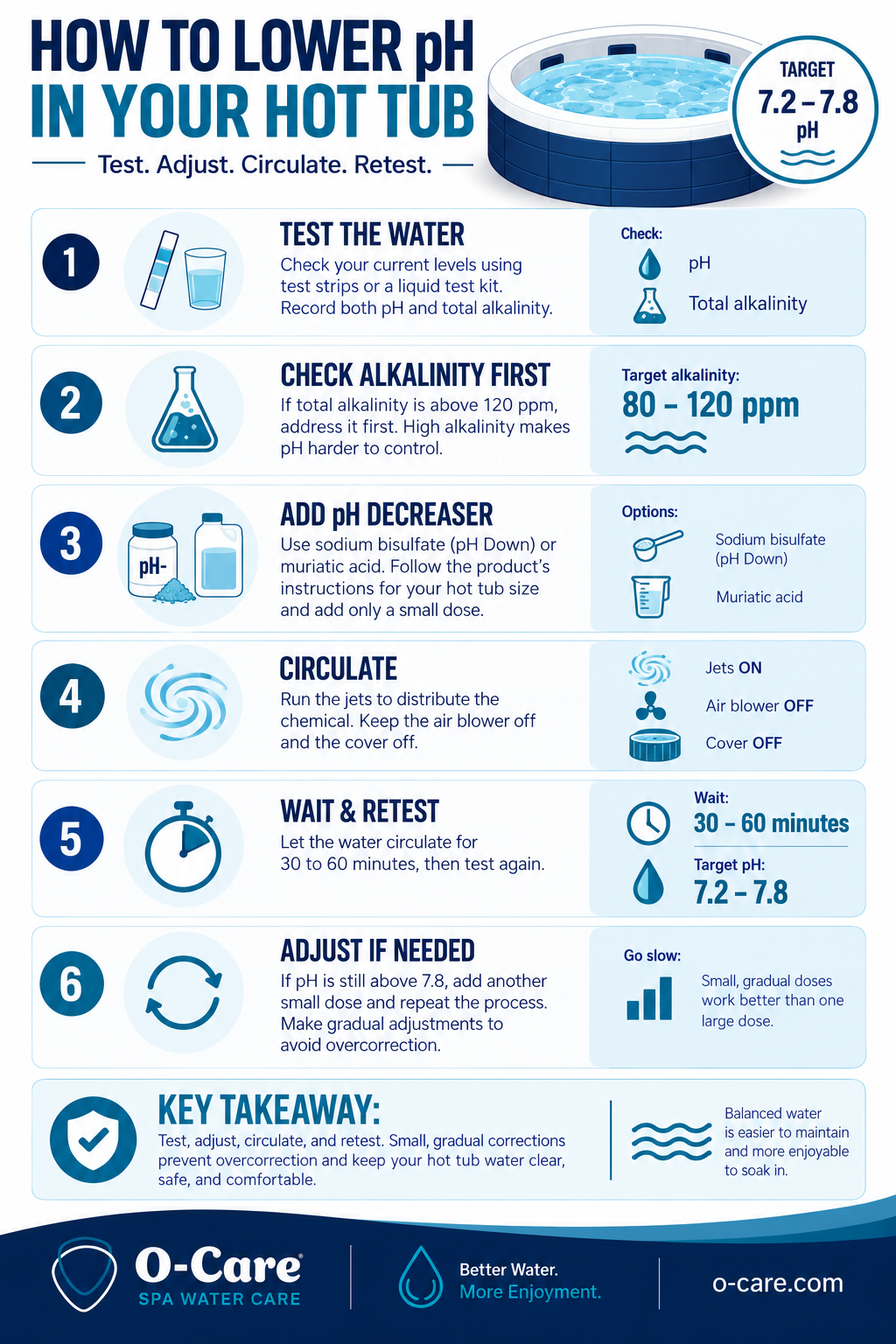
The fix: add a pH decreaser like sodium bisulfate or muriatic acid in small doses, jets circulating and the air blower off, then retest after 30 to 60 minutes.
High total alkalinity locks pH in place and resists every correction you make. If that reading is also above 120 ppm, that’s usually why the number keeps climbing back. This guide covers both: how to lower pH on its own, and how to bring it down without dragging pH along for the ride.
Key Takeaways:
- Sodium bisulfate and muriatic acid are the two chemicals that lower hot tub pH
- High alkalinity makes pH harder to control, so address alkalinity first
- Test 2-3 times per week and before adding chemicals
- Small, gradual doses prevent overcorrection
Why Is Your Hot Tub pH Too High?
Hot tub pH rises because of aeration from jets, high alkalinity in source water, chemical additions, and bather load. Your hot tub’s jets push it up every session. Carbon dioxide escapes, your hot tub’s water gets less acidic, and pH climbs regardless. Understanding hot tub chemistry helps you fix it once, not chase it weekly.
1. Aeration from Jets
Running your hot tub jets causes carbon dioxide to escape from the water, which raises pH naturally over time. Same process that happens when you leave a carbonated drink open on the counter.
The more you run your hot tub’s jets, the faster pH climbs. Leaving the hot tub cover off during jet cycles accelerates this because CO2 escapes into the air more freely.
2. High Alkalinity Source Water
Your local water source, tap water or well water, may already contain high alkalinity levels that affect water chemistry from the first fill. A fresh refill can start well above 120 ppm alkalinity straight from the hose, before you’ve added a single chemical.
Using a hose pre-filter when filling your hot tub with fresh water removes dissolved minerals and reduces the mineral content that contributes to alkalinity problems. One step at fill time saves weeks of corrections.
3. Chemical Additions and Bather Load
Adding too many chemicals like basic hot tub chemicals, sanitizers, shock treatments, and clarifiers can push your hot tub’s pH level upward. Sodium bicarbonate (baking soda), which raises alkalinity, also nudges pH higher.
Heavy hot tub usage introduces body oils, lotions, and sweat. These dissolved minerals and organic compounds affect your hot tub’s water chemistry and cause sudden changes that catch you off guard mid-week.
How Do You Lower pH in a Hot Tub?
To lower pH in a hot tub, add sodium bisulfate (dry acid) or muriatic acid in small doses with the jets on and the air blower off, then retest after 30 to 60 minutes. The ideal pH level range is 7.2 to 7.8. Use the correct amount for your hot tub size, and stay gradual when adjusting pH.
1. Test Your Water First
Before adding any pH decreaser, test your hot tub’s water using a test strip or liquid test kit. Dip the test strip for the time specified in the instructions. Compare colors to the chart in natural light for more accurate readings.
Record both your pH level and total alkalinity readings. If total alkalinity is above 120 ppm, address alkalinity first because high alkalinity creates a buffering effect that resists changes to your pH level.
A liquid test kit provides more accurate readings than test strips. Collect a water sample from elbow depth and add the reagent drops as directed.
2. Choose Your pH Decreaser
Sodium bisulfate (dry acid) and muriatic acid are the two most effective pH reducer options for lowering pH in hot tub water. Each works differently and suits different situations.
What is the method?
How does it affect pH?
How does it affect alkalinity?
How fast does it work?
Who is it best for?
Sodium bisulfate (dry acid)
Lowers pH gently
Slight alkalinity decrease
30-45 minutes
Beginners and routine adjustments
Muriatic acid (hydrochloric acid)
Lowers pH quickly
Reduces alkalinity more
15-30 minutes
Experienced owners and stubborn high pH
White vinegar
Barely moves pH
Adds organic load, no real alkalinity benefit
Very slow, if at all
Not recommended
CO2 injection
Lowers pH
No alkalinity impact
Fast
Commercial setups with special equipment
General Dosage Guide:
What chemical?
How much per 500 gallons (1,900 L)?
What is the expected effect?
Sodium bisulfate
1 oz (28 g)
Lowers pH by ~0.1
Muriatic acid
1.25 fl oz (37 ml)
Lowers pH by ~0.1
Vinegar barely moves pH and adds organic load to your hot tub’s water, so white vinegar isn’t recommended as a pH decreaser.
Check the product label and your owner’s manual for precise dosing. Sodium bisulfate is the active ingredient in most pH Down products, and most labels call for about 1 ounce per 500 gallons of water to start. When in doubt, under-dose rather than over-dose. You can always add more after retesting.
3. Add the pH Decreaser Safely
For sodium bisulfate, turn the air blower off, keep the jets circulating on low, and sprinkle the powder evenly across the water surface. Leave the cover off and wait 30 to 60 minutes before retesting. Don’t run the air blower during this window.
For muriatic acid, dilute first: mix one part acid with ten parts water in a plastic bucket. With the air blower off, pour the diluted solution slowly along the perimeter of the hot tub while the jets circulate on low.
Safety steps when handling spa chemicals:
- Wear chemical-resistant gloves and splash-proof goggles
- Pour slowly to avoid splashes on skin or your hot tub’s surfaces
- Add one chemical at a time and wait before adding another
- Store chemicals in a cool, dark place away from flammables and direct sunlight
- Add the chemical to the water, not water to the chemical
- Don’t dose while anyone is in the hot tub, and wait for the recommended window before getting back in
- Wipe up any spills right away
4. Circulate and Retest
After adding a pH decreaser, run the hot tub jets for at least 30 minutes to circulate the water evenly. This ensures the chemical distributes throughout your hot tub’s entire volume.
Wait 30 to 60 minutes before retesting. If your pH level is still above 7.8, add another small dose and repeat. Making gradual changes to pH levels prevents overcorrection, which can create new problems like low pH corroding metal fittings and damaging your hot tub’s pump seals.
Leave the hot tub cover off while balancing pH to allow for off-gassing of carbon dioxide.
How Do You Lower Alkalinity in a Hot Tub?
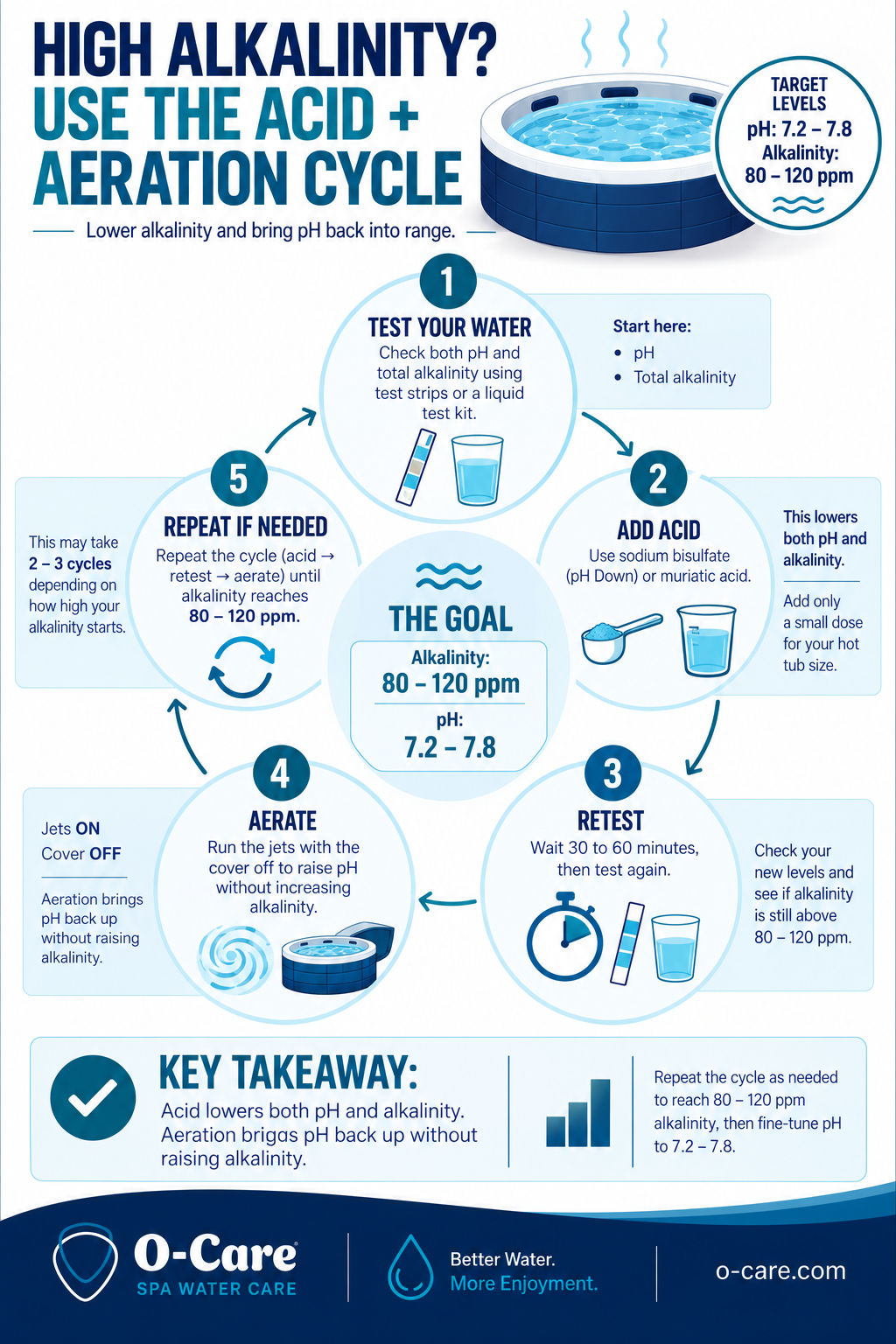
To lower alkalinity in a hot tub, add sodium bisulfate or muriatic acid to reduce total alkalinity, then use aeration to bring pH back into the ideal range. Total alkalinity should stay between 80 and 120 ppm for stable water balanced chemistry.
When your hot tub’s alkalinity climbs above 120 ppm, the problems multiply: cloudy water, scaling, skin irritation, and pH that ignores every correction.
1. Add Acid to Lower Both pH and Alkalinity
Both sodium bisulfate and muriatic acid work as an alkalinity decreaser because they neutralize the bicarbonates that create alkalinity. When acids are added to hot tub water, bicarbonates convert to carbonic acid. This lowers both pH and total alkalinity simultaneously.
The same chemicals that decrease pH also decrease alkalinity. There is no separate alkalinity-only chemical for hot tub use.
2. Aerate to Raise pH Back Up
After the acid brings both pH and alkalinity down, run the jets with the hot tub cover off to aerate the water. Aeration drives off carbon dioxide, which raises pH without raising alkalinity back up.
This is the technique that makes the whole process work: you can lower your hot tub’s alkalinity without permanently dropping pH below the ideal range. The aeration process takes several hours depending on how far pH needs to recover.
Turn on all jets and air features. Leave the spa cover off during this step so CO2 escapes into the air freely. This is essential hot tub maintenance when your spa water runs too alkaline.
3. Repeat Until Alkalinity Reaches 80-120 ppm
The acid-then-aerate cycle may need repeating 2 to 3 times to bring your hot tub’s alkalinity level into the recommended range. Test total alkalinity and pH after each cycle.
The full acid-then-aerate process follows this order:
- Test pH and total alkalinity for your baseline
- Add acid in small doses with jets running
- Wait 30 to 60 minutes, then retest both readings
- Run jets with the cover off to raise pH through aeration
- Repeat if alkalinity remains above 120 ppm
Stay patient with the process. Trying to reduce alkalinity in one large dose risks dropping pH dangerously low, and that swing is worse than the high alkalinity you started with.
Will pH Down Lower Alkalinity?
Yes, pH Down (sodium bisulfate) lowers both pH and alkalinity because it neutralizes the bicarbonate ions that make up total alkalinity. Every time you add a pH decreaser to your hot tub water, you are also reducing alkalinity. The two measurements are chemically linked because alkalinity is the water’s ability to neutralize acids and maintain stable pH levels.
Addressing high alkalinity first makes your pH level easier to control. If total alkalinity is too high, it creates a buffering effect that resists changes to pH. Lowering alkalinity reduces that buffer, making your pH adjustments more effective.
What did you add?
What happens to pH?
What happens to alkalinity?
Sodium bisulfate (pH Down)
Decreases
Decreases
Muriatic acid
Decreases
Decreases more
Aeration (jets + cover off)
Increases
No change
Baking soda
Slight increase
Increases
Read more: Why your pH keeps fluctuating
What Happens When pH or Alkalinity Is Too High?
High pH and high alkalinity cause cloudy water, scaling on hot tub equipment, reduced sanitizer effectiveness, and skin irritation that compounds over time. Chlorine and bromine lose effectiveness in unbalanced water, requiring higher sanitizer levels to maintain proper disinfection. According to the CDC Healthy Swimming Guidelines, maintaining proper water balance prevents skin irritation, equipment corrosion, and ineffective sanitization.
1. Equipment Damage and Scaling
When alkalinity climbs above 120 ppm, calcium deposits form on heaters, jets, and pump seals. This scale buildup restricts water flow, reduces heating efficiency, and shortens component lifespan.
The crusty white residue on your hot tub’s jet nozzles is the visible part. The scaling inside your hot tub’s heater element, the part you cannot see, is doing the real damage. Properly balanced water protects your investment.
2. Cloudy Water and Reduced Sanitizer Effectiveness
High alkalinity makes your hot tub water appear cloudy, foamy, or develop an unpleasant green tint. That haze is often your first visible clue, showing up well before your test strip confirms high pH or high alkalinity levels. Dissolved minerals precipitate out of solution and leave the water cloudy.
Chlorine and bromine work best in the 7.2 to 7.8 pH range. Above that range, sanitizer effectiveness drops, which can lead to bacteria and contaminant issues even when test strips show adequate chlorine levels.
3. Skin Irritation and Discomfort
High alkalinity and high pH can lead to dry, itchy skin and irritated eyes, especially for those with sensitivities. That tight feeling on your skin after a soak, the one you assumed was normal, is your water telling you something is off.
Signs of unbalanced water on your body:
- Dry, tight skin that persists after toweling off
- Red or irritated eyes within minutes of soaking
- Faded swimwear from excess chemical exposure
Maintaining water within the ideal range keeps the hot tub safe for your skin and ensures a comfortable soaking experience.
How Do You Test pH and Alkalinity Accurately?
Test your hot tub water 2 to 3 times per week using test strips or a liquid test kit, and test before adding any chemicals to get a baseline reading. Accurate testing is the foundation of hot tub pH that stays predictable instead of swinging between corrections.
Knowing your hot tub’s pH level before adding anything prevents overcorrection on the pH scale.
Infrequent testing lets alkalinity changes go unnoticed until they surface as cloudy water or scaling you have to scrape off your hot tub’s jets.
Test Strips vs Liquid Test Kits
Test strips offer quick, affordable readings: dip a test strip into your hot tub, wait the specified time, and compare colors to the chart in natural light. They measure pH, total alkalinity, chlorine, and other levels in parts per million.
For more accurate readings, use a liquid test kit. The resulting color change provides more precise measurements, which matters when you keep adjusting and nothing seems to stick.
How to use a liquid test kit:
- Collect a water sample from elbow depth, away from the jets
- Add the reagent drops as directed on the kit instructions
- Compare the color change against the provided chart in natural light
Read more: Digital Hot Tub Water Tester: Simplify Your Spa Maintenance
Testing Best Practices
Testing regularly helps you maintain pH balance and keeps the water comfortable for everyone who soaks in it.
- Test alkalinity first, since it dictates how your pH will behave
- Test at least 2 to 3 times per week during normal use
- Test before and after adding chemicals
- Collect water from elbow depth for a representative sample
- Compare colors in natural light for accurate readings
- Record results to track water chemistry trends over time
How Does Reducing Chemical Buildup Help pH Stability?
The constant back-and-forth with pH levels traces to the same root problem: organic buildup destabilizing your water chemistry. Biofilm and sediment accumulate in your plumbing and on your hot tub’s surfaces. Your sanitizer fights that load first, which means the chemical demand keeps climbing and pH swings get wider with every correction.
Why Addressing Organic Load Changes Everything
Piling on more chemicals to fix what more chemicals are partly causing keeps the cycle going. Addressing the organic load directly breaks it instead.
O-Care’s mineral salts reduce the buildup that makes water chemistry unpredictable. The corrections get smaller. The gaps between them get longer. You still test. You still adjust when needed. But you are adjusting a stable system, not chasing a number that moves every time you turn around.
What O-Care Does Not Replace
O-Care is not a pH balancer or a sanitizer. You still need chlorine or bromine in your hot tub’s water. What changes is how much you need and how often the numbers drift.
Less chemical load also means softer water on your skin, no chlorine smell clinging to you after a soak, and a maintenance routine that takes two minutes once a week.
Conclusion
Lowering pH in a hot tub uses sodium bisulfate or muriatic acid in gradual doses, with retesting after each adjustment to avoid overcorrection. When total alkalinity is also high, address it first using the acid-then-aerate cycle to bring alkalinity into the 80 to 120 ppm range.
Add acid to lower both readings, then run your hot tub’s jets with the cover off to bring pH back up while alkalinity stays down. Test 2 to 3 times per week and adjust in small increments.
If you want water that holds its balance instead of swinging back every few days, O-Care reduces chlorine and bromine demand by up to 78% while keeping the system predictable. Start with O-Care and stop chasing pH corrections.
Frequently Asked Questions
Can you lower pH without lowering alkalinity in a hot tub?
Not with acid alone: sodium bisulfate and muriatic acid lower both pH and alkalinity together. Bring both down with acid, then run the jets with the cover off to aerate. Aeration raises pH back up without raising alkalinity, landing you with it down and pH back in range.
How long after adding pH decreaser can you use the hot tub?
Wait at least 30 to 60 minutes after adding any pH decreaser before using the hot tub.
Run your hot tub’s jets during this time to distribute the chemical evenly. Retest the water before entering to confirm pH is within the 7.2 to 7.8 ideal range.
What causes pH to keep rising in a hot tub?
Aeration from running jets is the most common reason hot tub pH keeps climbing toward high pH, because CO2 escapes from the water each time jets operate.
High total alkalinity amplifies this effect. If pH rises repeatedly, test alkalinity and reduce it to the 80-120 ppm range.
Is baking soda the same as pH Down?
No. Baking soda (sodium bicarbonate) raises alkalinity and has a slight upward effect on pH, which is the opposite of pH Down.
pH Down products contain sodium bisulfate, which lowers both pH and alkalinity, the opposite job. Need to raise pH instead? See our guide to raising pH in a hot tub without chemicals.
How can you bring pH down quickly in a hot tub?
Muriatic acid works faster: most hot tubs see a measurable drop from high pH in 15 to 30 minutes versus 30 to 45 for the gentler option. Keep the air blower off, jets circulating, and cover off while it works, then retest before using the water again.
How long does it take for pH to go down in a hot tub?
Most pH decreasers show a measurable change in your pH level within 30 to 60 minutes of dosing, though full stabilization can take a little longer if alkalinity is also high. If pH doesn’t move after 60 minutes, retest and add another small dose rather than assuming the first dose failed.
Can you lower pH naturally in a hot tub?
No natural additive lowers pH as reliably as a proper pH decreaser. Reducing organic load and keeping alkalinity in range, covered above, make each dose of acid work more predictably, but they don’t replace it.
The test strip comes back dark again. You added pH Down two days ago, watched the number drop, and now it is right back above 7.8. But how to lower pH in hot tub water for good?
The fix: add a pH decreaser like sodium bisulfate or muriatic acid in small doses, jets circulating and the air blower off, then retest after 30 to 60 minutes.
High total alkalinity locks pH in place and resists every correction you make. If that reading is also above 120 ppm, that’s usually why the number keeps climbing back. This guide covers both: how to lower pH on its own, and how to bring it down without dragging pH along for the ride.
Key Takeaways:
- Sodium bisulfate and muriatic acid are the two chemicals that lower hot tub pH
- High alkalinity makes pH harder to control, so address alkalinity first
- Test 2-3 times per week and before adding chemicals
- Small, gradual doses prevent overcorrection
Why Is Your Hot Tub pH Too High?
Hot tub pH rises because of aeration from jets, high alkalinity in source water, chemical additions, and bather load. Your hot tub’s jets push it up every session. Carbon dioxide escapes, your hot tub’s water gets less acidic, and pH climbs regardless. Understanding hot tub chemistry helps you fix it once, not chase it weekly.
1. Aeration from Jets
Running your hot tub jets causes carbon dioxide to escape from the water, which raises pH naturally over time. Same process that happens when you leave a carbonated drink open on the counter.
The more you run your hot tub’s jets, the faster pH climbs. Leaving the hot tub cover off during jet cycles accelerates this because CO2 escapes into the air more freely.
2. High Alkalinity Source Water
Your local water source, tap water or well water, may already contain high alkalinity levels that affect water chemistry from the first fill. A fresh refill can start well above 120 ppm alkalinity straight from the hose, before you’ve added a single chemical.
Using a hose pre-filter when filling your hot tub with fresh water removes dissolved minerals and reduces the mineral content that contributes to alkalinity problems. One step at fill time saves weeks of corrections.
3. Chemical Additions and Bather Load
Adding too many chemicals like basic hot tub chemicals, sanitizers, shock treatments, and clarifiers can push your hot tub’s pH level upward. Sodium bicarbonate (baking soda), which raises alkalinity, also nudges pH higher.
Heavy hot tub usage introduces body oils, lotions, and sweat. These dissolved minerals and organic compounds affect your hot tub’s water chemistry and cause sudden changes that catch you off guard mid-week.
How Do You Lower pH in a Hot Tub?
To lower pH in a hot tub, add sodium bisulfate (dry acid) or muriatic acid in small doses with the jets on and the air blower off, then retest after 30 to 60 minutes. The ideal pH level range is 7.2 to 7.8. Use the correct amount for your hot tub size, and stay gradual when adjusting pH.
1. Test Your Water First
Before adding any pH decreaser, test your hot tub’s water using a test strip or liquid test kit. Dip the test strip for the time specified in the instructions. Compare colors to the chart in natural light for more accurate readings.
Record both your pH level and total alkalinity readings. If total alkalinity is above 120 ppm, address alkalinity first because high alkalinity creates a buffering effect that resists changes to your pH level.
A liquid test kit provides more accurate readings than test strips. Collect a water sample from elbow depth and add the reagent drops as directed.
2. Choose Your pH Decreaser
Sodium bisulfate (dry acid) and muriatic acid are the two most effective pH reducer options for lowering pH in hot tub water. Each works differently and suits different situations.
| What is the method? | How does it affect pH? | How does it affect alkalinity? | How fast does it work? | Who is it best for? |
| Sodium bisulfate (dry acid) | Lowers pH gently | Slight alkalinity decrease | 30-45 minutes | Beginners and routine adjustments |
| Muriatic acid (hydrochloric acid) | Lowers pH quickly | Reduces alkalinity more | 15-30 minutes | Experienced owners and stubborn high pH |
| White vinegar | Barely moves pH | Adds organic load, no real alkalinity benefit | Very slow, if at all | Not recommended |
| CO2 injection | Lowers pH | No alkalinity impact | Fast | Commercial setups with special equipment |
General Dosage Guide:
| What chemical? | How much per 500 gallons (1,900 L)? | What is the expected effect? |
| Sodium bisulfate | 1 oz (28 g) | Lowers pH by ~0.1 |
| Muriatic acid | 1.25 fl oz (37 ml) | Lowers pH by ~0.1 |
Vinegar barely moves pH and adds organic load to your hot tub’s water, so white vinegar isn’t recommended as a pH decreaser.
Check the product label and your owner’s manual for precise dosing. Sodium bisulfate is the active ingredient in most pH Down products, and most labels call for about 1 ounce per 500 gallons of water to start. When in doubt, under-dose rather than over-dose. You can always add more after retesting.
3. Add the pH Decreaser Safely
For sodium bisulfate, turn the air blower off, keep the jets circulating on low, and sprinkle the powder evenly across the water surface. Leave the cover off and wait 30 to 60 minutes before retesting. Don’t run the air blower during this window.
For muriatic acid, dilute first: mix one part acid with ten parts water in a plastic bucket. With the air blower off, pour the diluted solution slowly along the perimeter of the hot tub while the jets circulate on low.
Safety steps when handling spa chemicals:
- Wear chemical-resistant gloves and splash-proof goggles
- Pour slowly to avoid splashes on skin or your hot tub’s surfaces
- Add one chemical at a time and wait before adding another
- Store chemicals in a cool, dark place away from flammables and direct sunlight
- Add the chemical to the water, not water to the chemical
- Don’t dose while anyone is in the hot tub, and wait for the recommended window before getting back in
- Wipe up any spills right away
4. Circulate and Retest
After adding a pH decreaser, run the hot tub jets for at least 30 minutes to circulate the water evenly. This ensures the chemical distributes throughout your hot tub’s entire volume.
Wait 30 to 60 minutes before retesting. If your pH level is still above 7.8, add another small dose and repeat. Making gradual changes to pH levels prevents overcorrection, which can create new problems like low pH corroding metal fittings and damaging your hot tub’s pump seals.
Leave the hot tub cover off while balancing pH to allow for off-gassing of carbon dioxide.
How Do You Lower Alkalinity in a Hot Tub?
To lower alkalinity in a hot tub, add sodium bisulfate or muriatic acid to reduce total alkalinity, then use aeration to bring pH back into the ideal range. Total alkalinity should stay between 80 and 120 ppm for stable water balanced chemistry.
When your hot tub’s alkalinity climbs above 120 ppm, the problems multiply: cloudy water, scaling, skin irritation, and pH that ignores every correction.
1. Add Acid to Lower Both pH and Alkalinity
Both sodium bisulfate and muriatic acid work as an alkalinity decreaser because they neutralize the bicarbonates that create alkalinity. When acids are added to hot tub water, bicarbonates convert to carbonic acid. This lowers both pH and total alkalinity simultaneously.
The same chemicals that decrease pH also decrease alkalinity. There is no separate alkalinity-only chemical for hot tub use.
2. Aerate to Raise pH Back Up
After the acid brings both pH and alkalinity down, run the jets with the hot tub cover off to aerate the water. Aeration drives off carbon dioxide, which raises pH without raising alkalinity back up.
This is the technique that makes the whole process work: you can lower your hot tub’s alkalinity without permanently dropping pH below the ideal range. The aeration process takes several hours depending on how far pH needs to recover.
Turn on all jets and air features. Leave the spa cover off during this step so CO2 escapes into the air freely. This is essential hot tub maintenance when your spa water runs too alkaline.
3. Repeat Until Alkalinity Reaches 80-120 ppm
The acid-then-aerate cycle may need repeating 2 to 3 times to bring your hot tub’s alkalinity level into the recommended range. Test total alkalinity and pH after each cycle.
The full acid-then-aerate process follows this order:
- Test pH and total alkalinity for your baseline
- Add acid in small doses with jets running
- Wait 30 to 60 minutes, then retest both readings
- Run jets with the cover off to raise pH through aeration
- Repeat if alkalinity remains above 120 ppm
Stay patient with the process. Trying to reduce alkalinity in one large dose risks dropping pH dangerously low, and that swing is worse than the high alkalinity you started with.
Will pH Down Lower Alkalinity?
Yes, pH Down (sodium bisulfate) lowers both pH and alkalinity because it neutralizes the bicarbonate ions that make up total alkalinity. Every time you add a pH decreaser to your hot tub water, you are also reducing alkalinity. The two measurements are chemically linked because alkalinity is the water’s ability to neutralize acids and maintain stable pH levels.
Addressing high alkalinity first makes your pH level easier to control. If total alkalinity is too high, it creates a buffering effect that resists changes to pH. Lowering alkalinity reduces that buffer, making your pH adjustments more effective.
| What did you add? | What happens to pH? | What happens to alkalinity? |
| Sodium bisulfate (pH Down) | Decreases | Decreases |
| Muriatic acid | Decreases | Decreases more |
| Aeration (jets + cover off) | Increases | No change |
| Baking soda | Slight increase | Increases |
Read more: Why your pH keeps fluctuating
What Happens When pH or Alkalinity Is Too High?
High pH and high alkalinity cause cloudy water, scaling on hot tub equipment, reduced sanitizer effectiveness, and skin irritation that compounds over time. Chlorine and bromine lose effectiveness in unbalanced water, requiring higher sanitizer levels to maintain proper disinfection. According to the CDC Healthy Swimming Guidelines, maintaining proper water balance prevents skin irritation, equipment corrosion, and ineffective sanitization.
1. Equipment Damage and Scaling
When alkalinity climbs above 120 ppm, calcium deposits form on heaters, jets, and pump seals. This scale buildup restricts water flow, reduces heating efficiency, and shortens component lifespan.
The crusty white residue on your hot tub’s jet nozzles is the visible part. The scaling inside your hot tub’s heater element, the part you cannot see, is doing the real damage. Properly balanced water protects your investment.
2. Cloudy Water and Reduced Sanitizer Effectiveness
High alkalinity makes your hot tub water appear cloudy, foamy, or develop an unpleasant green tint. That haze is often your first visible clue, showing up well before your test strip confirms high pH or high alkalinity levels. Dissolved minerals precipitate out of solution and leave the water cloudy.
Chlorine and bromine work best in the 7.2 to 7.8 pH range. Above that range, sanitizer effectiveness drops, which can lead to bacteria and contaminant issues even when test strips show adequate chlorine levels.
3. Skin Irritation and Discomfort
High alkalinity and high pH can lead to dry, itchy skin and irritated eyes, especially for those with sensitivities. That tight feeling on your skin after a soak, the one you assumed was normal, is your water telling you something is off.
Signs of unbalanced water on your body:
- Dry, tight skin that persists after toweling off
- Red or irritated eyes within minutes of soaking
- Faded swimwear from excess chemical exposure
Maintaining water within the ideal range keeps the hot tub safe for your skin and ensures a comfortable soaking experience.
How Do You Test pH and Alkalinity Accurately?
Test your hot tub water 2 to 3 times per week using test strips or a liquid test kit, and test before adding any chemicals to get a baseline reading. Accurate testing is the foundation of hot tub pH that stays predictable instead of swinging between corrections.
Knowing your hot tub’s pH level before adding anything prevents overcorrection on the pH scale.
Infrequent testing lets alkalinity changes go unnoticed until they surface as cloudy water or scaling you have to scrape off your hot tub’s jets.
Test Strips vs Liquid Test Kits
Test strips offer quick, affordable readings: dip a test strip into your hot tub, wait the specified time, and compare colors to the chart in natural light. They measure pH, total alkalinity, chlorine, and other levels in parts per million.
For more accurate readings, use a liquid test kit. The resulting color change provides more precise measurements, which matters when you keep adjusting and nothing seems to stick.
How to use a liquid test kit:
- Collect a water sample from elbow depth, away from the jets
- Add the reagent drops as directed on the kit instructions
- Compare the color change against the provided chart in natural light
Read more: Digital Hot Tub Water Tester: Simplify Your Spa Maintenance
Testing Best Practices
Testing regularly helps you maintain pH balance and keeps the water comfortable for everyone who soaks in it.
- Test alkalinity first, since it dictates how your pH will behave
- Test at least 2 to 3 times per week during normal use
- Test before and after adding chemicals
- Collect water from elbow depth for a representative sample
- Compare colors in natural light for accurate readings
- Record results to track water chemistry trends over time
How Does Reducing Chemical Buildup Help pH Stability?
The constant back-and-forth with pH levels traces to the same root problem: organic buildup destabilizing your water chemistry. Biofilm and sediment accumulate in your plumbing and on your hot tub’s surfaces. Your sanitizer fights that load first, which means the chemical demand keeps climbing and pH swings get wider with every correction.
Why Addressing Organic Load Changes Everything
Piling on more chemicals to fix what more chemicals are partly causing keeps the cycle going. Addressing the organic load directly breaks it instead.
O-Care’s mineral salts reduce the buildup that makes water chemistry unpredictable. The corrections get smaller. The gaps between them get longer. You still test. You still adjust when needed. But you are adjusting a stable system, not chasing a number that moves every time you turn around.
What O-Care Does Not Replace
O-Care is not a pH balancer or a sanitizer. You still need chlorine or bromine in your hot tub’s water. What changes is how much you need and how often the numbers drift.
Less chemical load also means softer water on your skin, no chlorine smell clinging to you after a soak, and a maintenance routine that takes two minutes once a week.
Conclusion
Lowering pH in a hot tub uses sodium bisulfate or muriatic acid in gradual doses, with retesting after each adjustment to avoid overcorrection. When total alkalinity is also high, address it first using the acid-then-aerate cycle to bring alkalinity into the 80 to 120 ppm range.
Add acid to lower both readings, then run your hot tub’s jets with the cover off to bring pH back up while alkalinity stays down. Test 2 to 3 times per week and adjust in small increments.
If you want water that holds its balance instead of swinging back every few days, O-Care reduces chlorine and bromine demand by up to 78% while keeping the system predictable. Start with O-Care and stop chasing pH corrections.
Frequently Asked Questions
Can you lower pH without lowering alkalinity in a hot tub?
Not with acid alone: sodium bisulfate and muriatic acid lower both pH and alkalinity together. Bring both down with acid, then run the jets with the cover off to aerate. Aeration raises pH back up without raising alkalinity, landing you with it down and pH back in range.
How long after adding pH decreaser can you use the hot tub?
Wait at least 30 to 60 minutes after adding any pH decreaser before using the hot tub.
Run your hot tub’s jets during this time to distribute the chemical evenly. Retest the water before entering to confirm pH is within the 7.2 to 7.8 ideal range.
What causes pH to keep rising in a hot tub?
Aeration from running jets is the most common reason hot tub pH keeps climbing toward high pH, because CO2 escapes from the water each time jets operate.
High total alkalinity amplifies this effect. If pH rises repeatedly, test alkalinity and reduce it to the 80-120 ppm range.
Is baking soda the same as pH Down?
No. Baking soda (sodium bicarbonate) raises alkalinity and has a slight upward effect on pH, which is the opposite of pH Down.
pH Down products contain sodium bisulfate, which lowers both pH and alkalinity, the opposite job. Need to raise pH instead? See our guide to raising pH in a hot tub without chemicals.
How can you bring pH down quickly in a hot tub?
Muriatic acid works faster: most hot tubs see a measurable drop from high pH in 15 to 30 minutes versus 30 to 45 for the gentler option. Keep the air blower off, jets circulating, and cover off while it works, then retest before using the water again.
How long does it take for pH to go down in a hot tub?
Most pH decreasers show a measurable change in your pH level within 30 to 60 minutes of dosing, though full stabilization can take a little longer if alkalinity is also high. If pH doesn’t move after 60 minutes, retest and add another small dose rather than assuming the first dose failed.
Can you lower pH naturally in a hot tub?
No natural additive lowers pH as reliably as a proper pH decreaser. Reducing organic load and keeping alkalinity in range, covered above, make each dose of acid work more predictably, but they don’t replace it.


 English
 Dutch
 German
 French